ARITA welcomes ASIC’s review of SBRs
21/07/2025
ARITA welcomes ASIC’s review of the small business restructuring (SBR) process, which shows it is increasingly supporting business survival. However, ARITA shares concerns about ongoing potential misuse and acknowledges the need for ongoing monitoring. ARITA remains committed to supporting and improving the SBR framework.
The Australian Securities and Investments Commission (ASIC) has released its report Review of small business restructuring process: 2022–24 that reviews the small business restructuring (SBR) process for the period 1 July 2022 to 31 December 2024.
The report captures selected data for 3,388 SBRs that commenced during the review period, with the key finding being that the SBR process is beginning to achieve its policy objective of meeting "the needs of small business to support increased productivity and innovation by reducing the complexity and costs involved in insolvency processes … and ultimately helping small businesses to survive".
Key insights from the report
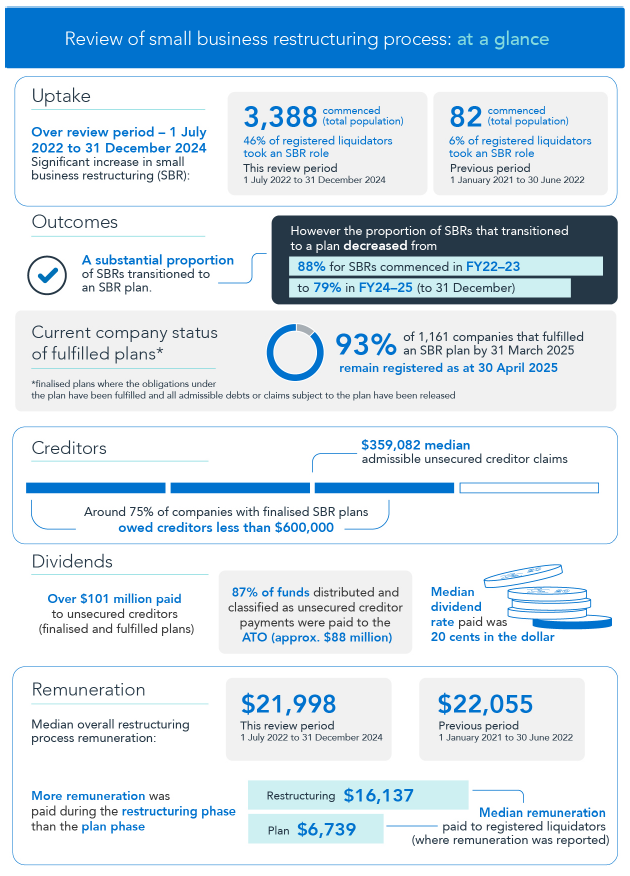
There has been a significant increase in the number of SBR appointments since ASIC previous report on SBRs was published (REP 756 covering appointments from 1 July 2021 to 30 June 2022). Appointments rose from 448 in 2022–23 to 1,425 in 2023–24, with the number anticipated to reach around 3,000 for 2024–25.
 |
|
© ASIC June 2025 | REP 810 Review of small business restructuring process: 2022–24, p7.
|
In respect of the outcomes of SBR Appointments, of the plans sent to creditors for SBRs commenced during the review period, 87% were approved. However, the rate of SBRs transitioning to a plan has declined, from 88% for FY22–23 to 79% for FY24–25 (to 31 December 2024), primarily due to an increase in plans being rejected by creditors.
As of 31 March 2025, of the approved plans, 55% remain ongoing and 41% have been finalised and fulfilled. Overall, 92% of finalised SBR plans were fulfilled. Approximately 93% of companies with a fulfilled restructuring plan remained registered at the end of April 2025, suggesting the SBR process is helping small businesses survive, at least in the short term.
Over $101 million has been paid to unsecured creditors for finalised and fulfilled plans commenced during the review period, with 87% of that paid to the ATO as the major creditor in at least 93% of fulfilled plans.
The median dividend rate was 20 cents in the dollar (average: 21 cents in the dollar). 87% of finalised plans have unsecured creditors owed between $0 and $800,000, well within the $1 million eligibility requirement.
Looking at the issue of the cost of the process, the median remuneration for the overall restructuring process was $21,998, which is broadly stable since the previous report.
In respect of fulfilled plans that paid a dividend, 78% had SBR plan remuneration at a rate no higher than 15% of the total dividend amount paid to unsecured creditors.
Potential Misuse of the SBR Process
It was pleasing to see that ASIC's analysis found no evidence to indicate widespread misuse of the SBR process at this stage based on available structured data.
It was found that legislative safeguards are in place to protect against misuse, such as strict eligibility criteria, restrictions on company transactions during restructuring and preservation of creditor rights. Although, with the increasing numbers of SBRs, ARITA is starting to see interpretation issues with legislation around eligibility, particularly in respect of the group exception and where a former director of a company, that has used an SBR process after their resignation, may be excluded from using an SBR for seven years.
Stakeholders have raised concerns including practitioners charging lower fees initially and then increasing them. ARITA has not received many queries about remuneration and believes that generally the restrictions around remuneration in SBRs is well understood by members. Though we encourage members to ensure that any remuneration arrangements for their SBR appointments meet the strict requirements of the legislation.
The report highlighted that the regime is potentially failing to address root causes of financial distress. As the focus of the regime is for the restructuring practitioner to assist the company with reaching a compromise with creditors and that there is pressure to keep fees for the appointment as low as possible, this finding is not surprising. Directors will need to obtain further expert advice to resolve any underlying structural issues of the business.
The report also commented on SBRs being used to facilitate illegal phoenix activity and concerning advertising practices. From ARITA’s perspective, these and other sharp practices are areas for monitoring by ASIC to ensure that improper practices do not undermine the value of the regime.
ARITA has issued guidance for members regarding the promotion of SBRs to ensure that it does not breach the Code of Professional Practice or similar provisions in APES 110 Code of Ethics for Professional Accountants.
Looking forward
As the proponent of a small business restructuring regime since its thought leadership paper in 2014 – “A platform for recovery” - ARITA is pleased to see the increased numbers of SBR appointments. However, we maintain our position that SBRs could be better, and that legislative reform is needed to streamline the process and remove unnecessary red tape which would make them more efficient from an implementation and cost perspective. This position was supported by the Parliamentary Joint Committee 2022 report “Corporate insolvency in Australia” where timely legislative reform to the SBR regime was recommended.
ARITA will continue to monitor issues with the practical implementation of the legislation and push for legislative reform.
ARITA encourages any professional members with questions about the SBR process to review its comprehensive Guidance for practitioners on Small Business Restructuring, which is regularly updated or contact them via Ask ARITA.